
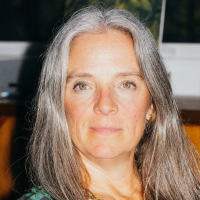

Katie Dreke is the Founder of DRKE, a global strategy collective focused on bridging brand, digital transformation, and storytelling. Over the past 25+ years, she’s guided some of the world’s most influential companies. She sat down with brand.ai’s founder, Michael Carter, to talk about science fiction, Gen Z, and how AI can foster more creativity.
MC
You've talked about the neurological synchrony of shared experiences. What does that come from?
KD
It most recently came up through my work with the Steamboat Springs ski resort. They'd been telling a different story each winter, which means they were missing a strong through line. We landed on a new platform for their 60th anniversary called “The Steamboat Way” and expressed it initially through cowboy poetry. Over the next few seasons it moved into music. We started realizing we were creating a special synergy with our audience in ways that had to do with rhythm, tempo, movement.
Music is an obvious one. If you're singing together, you're searching for the notes, trying to create harmony. There's the sound of other people's voices in your ears along with your own voice vibrating in your own cranium, across your bones. But even if you're just listening to music with another person, or if you go to a listening room and really slow yourself down, when scientists study this, you can see people's brainwaves get into the same observable pattern. Poetry does the same thing. Dancing does the same thing. So does sport, and physical movements of all types.
“A ritual or practice holds different weight. It’s not merely empty habit formation. It’s a somatic practice that involves building a rhythm through your whole nervous system, and it’s something that can infect and affect others around you.”
You can say, "I'm putting together a training plan," or you can say, "I'm creating a ritual, a practice." A ritual or practice holds different weight. It’s not merely empty habit formation. It’s a somatic practice that involves building a rhythm through your whole nervous system, and it’s something that can infect and affect others around you.
All these examples are from the real world. The analog world. With AI, there's a lot of brands exploring synthetic versions of themselves right now. However, I've been strongly advising my outdoor and sport clients especially: don't depict your ethos and experience in a synthetic way. Film real humans in the real world. Help people experience real gravity, real weather, and real physical joy.
If you're going to utilize AI superpowers, apply it to operational elements. If you’re a brand in the outdoor or sport arena, you own something precious that connects people’s bodies to the natural world – that is becoming more rare and magical. Don't sully it with a cheap synthetic imitation.

MC
You've said before that veneer branding is dead. But a lot of brand work is still exactly that.
KD
Let’s rewind a little. You graduate from university and you start working. You roll through your twenties and thirties, and after you've received enough briefs, you start to see the Matrix instead of just playing the game. "Oh, this brief is because the product hasn't changed but they're trying to drive more sales." We've all received those ‘smoke screen’ briefs. Wallpaper over a crack in the wall with a cool poster. It feels shameful once you start to recognize it.
Like other strategists, I started trying to claw my way closer to the source waters. “Where did this brief come from? Why are we spending money on wallpaper instead of the wall? What’s really going on here?”
A rebrand needs a genuine reason. Sometimes it's executives feeling like the product's not doing anything interesting, so let's get the brand to look different. That's a hollow agenda. Let's paint the car, but there's still no engine in it. That’s a losing game.
Startups will rightly focus on the product, but then suddenly get to the point where they're like, "Okay, we really believe in our product now. But now we're embarrassed to be walking around in this unsophisticated brand." That's a perfect time for a rebrand.
But veneer branding isn't just ineffective—it's dangerous. Think of it like painting a rusted bridge. It looks better, so now people trust it more and cross it even when the builder knows the structure underneath is unsafe.
“But veneer branding isn't just ineffective—it's dangerous. Think of it like painting a rusted bridge. It looks better, so now people trust it more and cross it even when the builder knows the structure underneath is unsafe.”
To be fair to some brands, there are always interesting dynamics at play. I once worked with a Nordic fashion brand on sustainability. Behind the scenes, they were doing incredible work, funding startups, employing scientists to develop new material innovations. Spending real money on the real problem. But culturally, they were very uncomfortable tooting their own horn. Nordic culture frowns on such a thing.
I was like, "The world needs to know the amount of investment you’re making on this problem!" The brief asked for a marketing veneer, but the right solution meant elevating this work to the corporate vision level. Executive-led. PR-first. Marketing merely as support. They needed to feel comfortable doing it in a way that felt authentic to their cultural identity as well as their business goals.

MC
You’ve often used the nervous system as a metaphor for brand strategy and brand development. What does that look like for you in practice?
KD
It's messier than most people are comfortable with. Consider the following: My husband has a cousin who's a long-distance runner. During cross country season, her legs get overdeveloped and her arms get lean. But over the summer months she goes north to Alaska and works the fishing boats, which makes the muscles in her arms overdeveloped while her legs get lean. Organizations often work the same way. Different leaders drive different agendas. Capabilities are built up, and then left fallow. It’s hard to keep equilibrium across the whole enterprise. Things can easily get out of whack.
Your competitors are doing different things to wound you at different times. Sometimes there's a shift in the broad economic scenario—inflation gets out of hand, people pull back spending. It may have nothing to do with how wonderful your brand or your products are. The competitive ‘weather system’ has simply changed around you while you stood still.
Sometimes the extremities of a brand thrive while the center struggles. I worked on one client where the best expression of their global brand was in Latin America, but they couldn’t seem to replicate it in Europe where they're headquartered.
Digital changes happen fast. Ecom product copy can be flipped in hours. Retail might take two years to turn over the full physical fleet. And then you train human beings—sometimes they absorb it, sometimes they resist.
"It is like tending a garden in that there can be an ice storm and your whole garden gets killed and you have to replant it the next day. You have to have that gardener's mindset, it’s not for everyone."

Different industries also have different metabolisms. How many shoes do you buy a year? How many cars do you buy a year? How many beers? When did you last upgrade your mobile phone? The corporate board changes slowly. The CEO changes slowly. Culture changes fast. Layoffs happen fast. Competition can jump-scare you overnight.
Sometimes even the best laid nervous systems sensors will fail. At Nike Women, we discovered we were calling products "tights" and women were searching for "leggings." That one sensor failure lost sales to Lululemon.
It's a dynamic never-ending story. You're never going to get to the end. It is like tending a garden in that there can be an ice storm and your whole garden gets killed and you have to replant it the next day. You have to have that gardener's mindset, it’s not for everyone.
MC
What do you think Gen Z is sensing that older generations are missing?
KD
I'm Gen X, so I think we're the best. But I have two kids—22 and 19. Born right around when the iPhone came out. It's been interesting telling them about my childhood. Get on your bike, ride around the neighborhood, come home when the sun goes down. If you wanted to see if somebody could play, you'd go to their house and knock on the door. If you wanted to call a friend from school, you sat on the bottom step in the kitchen because that’s where the phone was stuck to the wall.
Gen Z don't like being seen as the saviors of the universe. They don't like that previous generations taxed nature and societies in ways that feel really irresponsible. They don't like the pressure of feeling like they're being left to take out the garbage.
They're pretty good at interrogating what's real and what's not. They accept what's not real as long as it's trivial. But the minute they see manipulation—especially politics—it creates rage. "How dare adults try to trick us."
As for me, I can't properly read a news article anymore because the page is full of AI-generated slop. I'm like, "How much longer am I going to be able to know this is fake?" Pretty soon we won't be able to know, and then nothing matters.
When you can no longer decipher the world, you just stop listening.


MC
With everyone accessing the same AI tools, is distinctiveness still possible?
KD
At the moment, AI is pulling from the world of the known. There's danger in using AI to be distinctive when everybody's using the same dataset.
I counsel people to avoid starting with AI. What you'll get back is something somebody else is already thinking about. If you want to seed a brand concept, go inside first—human hands, heart, and mind. From there, use AI for speed. You can find the edges of your idea faster.
"AI pulls from the known. If you want to seed a brand concept, go inside first—human hands, heart, mind. Then use AI for speed."
I was working at Adidas in 2012. We gave regional teams global digital assets for a product launch. Japan said, "There's no Asian people in this creative. We're developing our own stuff." It went viral around the globe. Germany freaked out because it was “off brand”. AI is creating that kind of brand management dynamic again, loose, fast and much wilder.
Creative distinction is going to come from stubbornly human ideas, organic and imperfect, with AI in the supporting role of speed, interrogation and expansion.
MC
How does sci-fi shape your work?
KD
I read it almost exclusively. Ursula K. Le Guin, Kim Stanley Robinson, N.K. Jemisin, Octavia Butler. Not for escapism, but for the world-building. These authors spend enormous time on the "future mundane"—the background music, the lived-in details, the way human nature plays out in new systems. It's the same work I do as a strategist. Understand people, extrapolate thoughtfully, build plausible worlds.
The Mountain in the Sea by Ray Nayler is one of my recent favorites. A woman studying cephalopods discovers they've created a language. But her studies are funded by an AI company wanting to understand their unique sentience in order to exploit it. Cephalopods have a brain in their head, but they also have small brains in each of their arms. The arms have a certain degree of autonomy and agency. The brain doesn't always tell each arm what to do. The arms sense, and they feed back some information. Essentially they are thinking and sensing independently and at the same time, which is a wild experience to try and imagine.
"I find long-time to be very comforting. Largely because I'm not a character in that play. If I do my job well while I'm here, I'm maybe a good ancestor that helped nudge something into place for somebody down the line."
There is also a very nefarious side of AI in this book. One character we meet is hijacked, drugged at a bar, wakes up on a fishing vessel at sea. The fishing vessel is commanded by an AI computer. The only people on the vessel are the people pulling fish out of the ocean, and armed guards who threaten those workers with violence if they get out of line. The AI “captain” is looking at the weather and choosing the route. The boat is autonomously managed. The food is dispensed through an AI computer. It's modern slavery and very dark.
On a lighter note, I also work with the Long Now Foundation in San Francisco. They think in 10,000-year timescales. We've been a civilization, a society that's been slowly becoming more modern, over the last 10,000 years. Their point of view is: given our extreme power in this moment, it's our responsibility to think forward into the next 10,000 years.
I find long-time to be a very comforting thought space. Largely because I'm not a character in that play. If I do my job well while I'm here, I'm maybe a good ancestor that helped nudge something into place for somebody down the line. But really it's a way of extrapolating. And it helps me see the now more clearly when I stretch time really far out.

MC
You've called yourself a critical optimist. What aren't people paying attention to?
KD
In marketing circles, people are hyperventilating about AI. I want to shake the cage and shout: “AI should be doing different things!”
I would really love it if AI wasn't in our playground as much. Go mine asteroids for rare minerals. Go understand animals better and help us slow their extinction. Go make it possible to predict and avoid weather catastrophes. Go reinforce nature as its systems are being taxed more strenuously as it struggles to keep this whole biosphere going. I would love AI to be applied toward finding alternative energy sources. Agriculture. Getting pesticides out of the ground. Apply it to the real issues of the day.
At one of my clients, Deer Valley Ski Resort, out on the ski hill, an AI discovered that if we were to regrade a particular ski run the snow will stay on the hill 13% longer in the spring because it won't be getting melted by direct sunlight.
Making sure we don't have to waste energy blowing snow, and that we get to ski on the stuff that fell from the sky longer. That's cool.
Making more synthetic marketing? That's depressing.
"We’re experiencing a shift from scarcity to abundance, and now the scarce resource has become human judgment, not production capacity."
I think brands need to establish a "no-AI zone"—a set of experiences, rituals, or craft practices that are intentionally human, defended, and never automated. That's where future rarity lives. That's where the next advantage is. Not scale. Rarity.
Creativity will always need people. Hopefully people who understand how AI works, its promise, its peril, and are excited to have it as a sparring partner. Sure, brands can now generate 472 variations from 7 key images, and the question becomes: just because we can doesn't mean we should.
We’re experiencing a shift from scarcity to abundance, and now the scarce resource has become human judgment, not production capacity.
Once upon a time, the CMO or the Creative Director's role was much more authoritarian: "Follow my brand rules. Stay on the brand identity path. Ask for permission. Color inside the lines.”
But with AI now completely in the mix, we’re moving into something that feels a lot more like parenting: “Protect the human touch. Guide the precious seed idea. Be the guardian of weirdness, wildness, and imperfections. Maintain strategic patience and fluidity. Strong convictions and concepts loosely held. Act with engaged empathy.”
And the beat goes on…


